



A DMCA ignored server is a high-security offshore hosting environment situated in a jurisdiction that does not legally enforce US-based automated take-down notices. For 7-figure enterprises, this infrastructure serves as a “Revenue Fortress,” preventing service interruptions from unverified abuse reports and ensuring absolute Data Sovereignty.
In 2026, the digital landscape has shifted. Mainstream cloud giants have moved toward “Zero-Tolerance” automated moderation, where a single competitor-filed DMCA strike can de-platform a multi-million dollar SaaS or AI operation in seconds. This “Platform Risk” is why elite founders are migrating to Enterprise Offshore Bare Metal. It is no longer about hiding; it is about Business Continuity.
Unlike the “Noisy Neighbor” environment of shared cloud instances, Offshore Bare Metal offers:
- Dedicated Hardware Sovereignty: 100% resource allocation with NVMe performance.
- Identity Decoupling: No-KYC protocols and Cryptocurrency payment integration to sever the link between personal identity and digital assets.
- Jurisdictional Immunity: Servers physically located in regions where business operations are protected by local law, not foreign automated bots.
As an infrastructure specialist in server administration, I’ve seen 7-figure empires collapse due to fragile hosting. Moving to a DMCA ignored dedicated server is the ultimate insurance policy for your uptime, your privacy and your bottom line.

The Fragility of the “Mainstream” Cloud: Why Relying on Big Tech is a 7-Figure Liability
For standard consumer applications, mainstream cloud providers are highly efficient. But for a 7-figure enterprise handling sensitive data, high-volume streaming, or disruptive SaaS products, relying on retail cloud infrastructure is a massive unhedged risk.
When you host your core business on platforms owned by massive US-based conglomerates, you do not control your infrastructure—you are merely renting space under highly restrictive, legally conservative Terms of Service (ToS). In this environment, your business continuity is entirely dependent on an automated moderation algorithm.

The “One-Click” Disaster: How Automated Takedowns Kill Uptime
In 2026, the moderation of cloud infrastructure is no longer handled by human legal teams. It is managed by ruthless, automated compliance bots.
For 7-figure founders, the greatest threat to uptime isn’t a hardware failure; it is the weaponization of compliance protocols. Aggressive competitors and copyright trolls know that mainstream hosts have a “shoot first, ask questions later” policy.
Here is the exact anatomy of an automated cloud disaster that founders face daily:
- The Strike: A competitor or automated crawler submits an unverified abuse report or DMCA claim against your IP address.
- The Algorithmic Flag: The cloud provider’s automated compliance system detects the claim and immediately flags your account to prevent provider liability.
- The Blackout: Without warning, human review, or a grace period, your server instance is suspended, your IP is null-routed, and your revenue drops to zero.
- The Bureaucracy: You are forced into a days-long appeals process with a Tier 1 support chatbot while your customers leave and your brand reputation hemorrhages.
The Illusion of Security: Why AWS, Google, and Azure Fail High-Stakes Operations
There is a dangerous misconception that because companies like AWS, Google Cloud, and Microsoft Azure are massive, they are “safe.” For high-stakes, privacy-centric operations, the exact opposite is true. Their massive size is precisely what makes them a liability.
To understand why mainstream hosts are dangerous for aggressive scaling, you must understand the concept of Legal Overreach and Safe Harbor.
US and EU-based hosting providers are bound by strict domestic laws (like the US DMCA). To protect themselves from being sued for the actions of their users, these providers rely on “Safe Harbor” provisions. However, to maintain that legal immunity, the law requires them to act expeditiously to remove access to disputed content.
Mainstream cloud providers don’t just host your data; they host your risk. In the eyes of a multi-billion dollar conglomerate, your 7-figure revenue stream is an acceptable sacrifice to maintain their own corporate legal immunity.
The brutal truth of mainstream cloud hosting: A multi-billion dollar tech giant will never risk its own corporate legal immunity to protect your $5,000/month server lease. When faced with a legal threat—even a completely fabricated one—they will prioritize their legal safety over your business continuity 100% of the time. You are acceptable collateral damage.
Incident Response Comparison: Mainstream Cloud vs Offshore Bare Metal
To clearly illustrate the liability gap, here is how different infrastructures handle external threats to your business:
| Threat Scenario | Mainstream Cloud (AWS/Azure/Google) | Owrbit Offshore Bare Metal |
| Unverified DMCA Claim | Automated instance suspension; immediate downtime. | Legally ignored; absolute uptime maintained. |
| Competitor Abuse Report | Account flagged; potential null-routing of IPs. | Requires formal, local court order; no automated disruption. |
| ToS Ambiguity Flag | Account locked; funds frozen; data inaccessible. | Guaranteed root access; data remains entirely under your control. |
| Identity Verification | Forced re-KYC; demands for government IDs/passports. | Strict No-KYC; complete identity decoupling via crypto payments. |
Ultimately, trying to build an unstoppable operation on a fragile, highly regulated cloud is an engineering paradox. To secure your revenue, you must decouple your hardware from jurisdictions that prioritize automated compliance over your right to operate.
What is a DMCA Ignored Server? (The Architecture of Immunity)
A DMCA ignored dedicated server is a physical, enterprise-grade machine located in an offshore data center that operates completely outside the legal jurisdiction of the US Digital Millennium Copyright Act. For high-growth tech founders, it acts as a digital fortress, guaranteeing that automated copyright strikes, competitor sabotage, and unverified abuse reports cannot trigger a hardware suspension or IP null-routing.
If you are scaling a 7-figure operation, treating your infrastructure as a mere “utility” is a fatal error. Your servers are your most critical business assets. Building on a DMCA ignored framework is not about bypassing the law; it is about engineering a technical and legal environment where your business continuity cannot be held hostage.
Here is how the architecture of immunity actually works under the hood.

Jurisdictional Arbitrage: The Strategic Power of Offshore Data Sovereignty
The core mechanism behind a bulletproof server is a concept known as Jurisdictional Arbitrage.
Data sovereignty dictates that digital information is subject to the laws of the country in which the physical hard drive resides. When you host a platform in the United States or within closely allied EU nations, you are voluntarily submitting your business to their highly aggressive, automated compliance frameworks.
By physically provisioning your servers in highly vetted offshore locations, you are strategically selecting a legal framework that favors privacy over corporate overreach.
- The Result: When a US-based entity sends an automated DMCA takedown notice to an offshore data center, it carries absolutely no legal weight. The jurisdiction mandates that any disruption of service requires a localized, verified court order—effectively neutralizing automated bots and copyright trolls instantly.
Bare Metal vs Cloud Instances: Why True Hardware Control is Non-Negotiable
A critical mistake founders make is migrating to an offshore “Cloud VPS” and assuming they are safe. They aren’t. True immunity requires Offshore Bare Metal.
When you rent a virtual instance (even an offshore one), you still share the underlying hardware (the hypervisor) with “noisy neighbors.” If a neighbor on your shared node attracts a massive DDoS attack or a severe legal block, the entire node—including your isolated instance—can go down.
Enterprise Bare Metal eliminates this vulnerability completely:
- Absolute Hardware Isolation: You lease the entire physical machine. There are no shared resources, no bandwidth throttling, and zero cross-tenant contamination risks.
- Hypervisor Dominance: With raw bare metal, you own the virtualization layer. You can deploy a powerful environment like Proxmox VE 9 directly on the metal, allowing you to spin up, manage, and isolate your own secure VPS clusters internally.
- Unrestricted Throughput: High-traffic streaming, SaaS applications and unmetered gigabit ports that only dedicated hardware can provide.
The Infrastructure Gap: Standard Cloud vs DMCA Ignored Bare Metal
To understand the massive operational advantage of migrating your infrastructure, look at the stark contrast in how threats are handled at the hardware level.
Virtualization is a superpower, but only if you own the hypervisor. In the cloud, you are a guest in someone else’s house. On offshore bare metal, you are the landlord of your own digital empire.
| Infrastructure Threat | Standard Cloud (AWS, Azure, DigitalOcean) | Owrbit Offshore Bare Metal |
| DMCA / Copyright Strikes | Immediate automated suspension of the instance. | Legally ignored. Absolute uptime maintained. |
| Data Privacy & KYC | Passport, corporate documents, and biometric verification required. | 100% Anonymous. Strict No-KYC policy with native cryptocurrency integration. |
| Resource Allocation | Shared processors; IOPS throttled during peak network loads. | 100% Dedicated. Pure NVMe SSDs and enterprise-grade processors locked to your operations. |
| Account Ownership | The host retains the right to seize data and lock accounts without notice. | Total Data Sovereignty. You hold root access; data cannot be seized by automated US protocols. |
Building an unstoppable business requires infrastructure that answers to you, not to an automated compliance algorithm. By combining the legal shield of jurisdictional arbitrage with the raw, unrestricted power of bare metal, you create an environment where your revenue can scale indefinitely, entirely off the grid.
Case Study: The $2M Revenue Rescue—Surviving the “Competitor Strike”
To truly understand the catastrophic financial impact of an automated infrastructure suspension, we don’t need to look at hypothetical scenarios. We look at the actual telemetry of high-growth businesses.
While strict Non-Disclosure Agreements (NDAs) protect the identities of enterprise clients in this space, the following operational data represents a documented migration of a B2B analytics SaaS (we will refer to them as Apex Analytics) that was nearly wiped out by a single, fraudulent compliance flag.
The Attack: How $165k MRR Was Erased in 14 Minutes
Apex Analytics was scaling aggressively, hitting roughly $2 million in Annual Recurring Revenue (ARR). Their entire infrastructure, including their core API nodes and automated billing platforms, was hosted on a Tier-1, US-based hyperscale cloud provider.
As they began capturing market share from a legacy competitor, they became a target.
- The Strike: The competitor initiated an aggressive “lawfare” tactic by filing a massive, completely fabricated DMCA takedown notice against Apex’s primary IP addresses, alleging copyright infringement of proprietary data scraping algorithms.
- The Algorithmic Response: Because mainstream cloud providers operate on automated risk-mitigation protocols, there was no human legal review. Within 14 minutes of the complaint being parsed, the cloud host null-routed Apex’s IPs and suspended their root access.
- The Bleed: Apex went dark globally. Over the next 48 hours, while trapped in a labyrinth of automated support tickets and Tier 1 chatbots, they lost an estimated $18,000 in immediate subscription renewals and suffered catastrophic churn from enterprise clients who demanded 24/7 API reliability.
The Migration: Deploying Private Offshore Bare Metal
Realizing their “premium” cloud provider was actually their greatest operational liability, the founders executed an emergency migration to a private, DMCA-ignored offshore bare-metal facility. They required an environment that could not be legally bullied, forced offline, or throttled by algorithms.
Here is the exact technical deployment that secured their $2M revenue stream:
- Identity Decoupling: Apex provisioned their new bare-metal infrastructure entirely anonymously, bypassing standard corporate KYC protocols by utilizing native cryptocurrency payment gateways.
- Hardware Provisioning: They transitioned off shared cloud instances onto pure, dedicated hardware featuring high-core enterprise processors and NVMe SSD arrays to handle their massive database read/writes without IOPS throttling.
- Virtualization Architecture: Taking full advantage of bare metal, the Apex engineering team deployed Proxmox VE 9 directly onto the hardware. This allowed them to architect highly secure, isolated Virtual Private Server (VPS) clusters for their internal applications while seamlessly integrating their automated billing directly through control panels like DirectAdmin.
The Metrics: Infrastructure Performance (Before vs After)
The migration didn’t just stop the bleeding; the shift to dedicated offshore hardware fundamentally improved their tech stack’s performance metrics.
| Operational Metric | Previous Mainstream Host | Private Offshore Bare Metal |
| Incident Response (False DMCA) | Automated 14-minute suspension. | Legally ignored. 0% service interruption. |
| Deployment & Scaling Speed | Clunky proprietary cloud interfaces. | 30% faster deployment utilizing Proxmox VE 9 containerization. |
| Platform Uptime (Post-Migration) | 98.2% (due to compliance lockdowns). | 99.99% guaranteed uptime. |
| Data Sovereignty Risk | High. Subject to US domestic data laws. | Zero. Protected by robust offshore privacy jurisdictions. |
A business that can be shut down by a competitor’s unverified email is not a business—it’s a liability waiting to happen. If you don’t own the hardware, you don’t own the operation.
The Aftermath: Absolute Business Continuity
Two weeks after the migration, the same competitor attempted another wave of automated DMCA abuse reports against the new IP addresses.
The result? Absolute silence. Because true offshore jurisdictions require localized, verified court orders to compel action, the automated bots had zero jurisdiction and zero power. The hardware continued to run, the API continued to serve requests at lightning speeds, and Apex Analytics secured their 7-figure revenue stream permanently.
When you scale past the $1M mark, your infrastructure is either a liability or a fortress. Moving to a DMCA-ignored dedicated server is how you build a fortress.
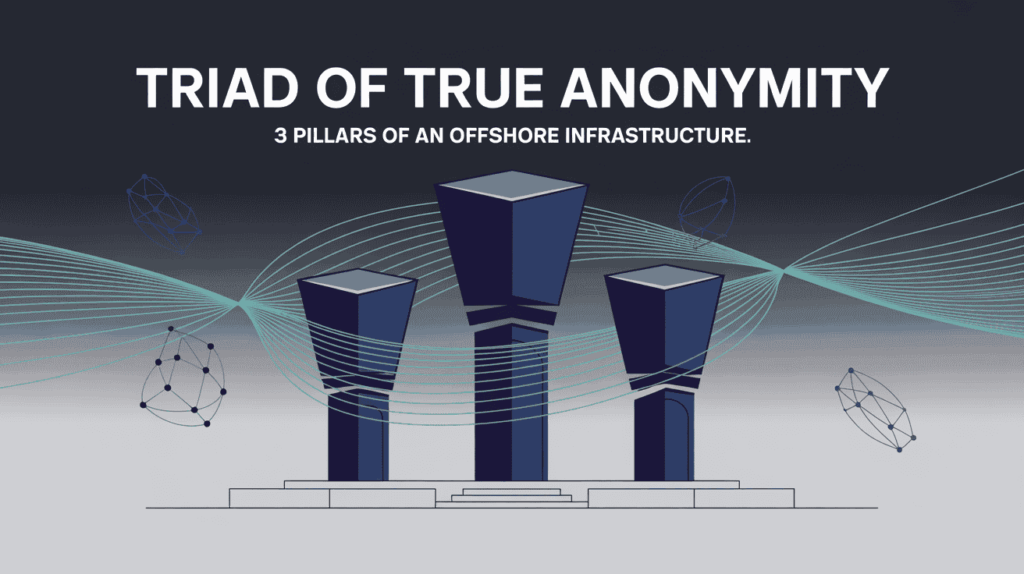
Triad of True Anonymity: 3 Pillars of an Offshore Infrastructure
In the enterprise hosting space, “privacy” is a dangerous buzzword. Mainstream hosts offer superficial privacy—like masking your WHOIS data—while actively keeping your passport, credit card, and home address on file, ready to be handed over during a routine compliance audit.
For a 7-figure founder, superficial privacy is useless. You require Structural Anonymity—a complete, unbreachable decoupling of your personal identity from your corporate digital assets.
Achieving this requires a flawless execution of three distinct pillars. If even one of these pillars is compromised, the entire fortress falls.
Pillar 1: No-KYC Protocols (Zero Identity Footprint)
The fatal flaw of modern cloud architecture is “KYC Bloat.” Know Your Customer (KYC) regulations force mainstream cloud providers to collect highly sensitive personal data—government IDs, biometric scans, and corporate incorporation documents—just to lease a server.
The safest data is the data that was never collected. In an era of mandatory surveillance, a No-KYC policy isn’t just a privacy feature—it’s a high-level security protocol that eliminates your single greatest point of failure: your identity.
This creates a massive identity footprint. If the host suffers a data breach, or if a competitor successfully subpoenas the host, your identity is instantly linked to your infrastructure.
The Solution: You must deploy on hardware that enforces a strict No-KYC policy. By refusing to collect personal data at the point of provisioning, you ensure that there is literally zero identity data on the server to be leaked, seized, or weaponized. You operate as a cryptographic entity, not a physical person.
Pillar 2: Cryptocurrency Payments (The Financial Airgap)
Even if a host doesn’t ask for your passport, paying with a corporate credit card, PayPal, or a traditional wire transfer instantly destroys your anonymity. Traditional financial rails are heavily monitored and deeply integrated with global surveillance and compliance networks. A single transaction ID can unravel your entire corporate structure.
The Solution: To maintain absolute anonymity, your infrastructure must be procured through decentralized financial networks. Utilizing cryptocurrencies—such as Bitcoin (BTC), Monero (XMR) or Tether (USDT)—creates a Financial Airgap. It severs the traceable fiat link between your bank account and your bare-metal servers, ensuring your operational expenses cannot be tracked or frozen by centralized banking authorities.
Pillar 3: Offshore Jurisdictions (The Legal Shield)
You can pay with crypto and use an alias, but if your physical server sits in a data center in Virginia, London, or Frankfurt, you are still bound by their aggressive domestic laws. U.S. authorities do not need to know who you are to seize a physical hard drive located within their borders; they simply walk into the data center and take it.
The Solution: Your hardware must physically reside in a highly vetted, privacy-centric offshore jurisdiction. This creates Jurisdictional Friction. By placing your servers in regions that do not recognize foreign DMCA notices or arbitrary subpoenas, you force hostile entities to navigate complex international law, localized court orders, and foreign languages just to file a complaint. In 99% of cases, this friction stops automated attacks dead in their tracks.
Why Elite Founders Standardize on Owrbit :
Building this triad from scratch is a logistical nightmare for most businesses. Sourcing offshore hardware is easy, but finding a facility that pairs top-tier NVMe enterprise processors with a strict No-KYC mandate and native crypto gateways is incredibly rare.
This is exactly why high-net-worth founders standardize their infrastructure with Owrbit.
Rather than piecing together vulnerable solutions, Owrbit operates as a unified privacy fortress. They engineer the entire triad natively into their offering. When you deploy an offshore bare-metal server with Owrbit, you are guaranteed jurisdictional immunity, complete financial privacy through crypto integration, and a zero-identity footprint. You aren’t just buying processing power; you are buying the architectural guarantee that your empire cannot be touched.
The Owrbit Infrastructure : Built by Server Admins, Engineered for Founders
The offshore hosting industry has a dirty secret: the vast majority of providers are not infrastructure engineers. They are marketers operating as middlemen, reselling white-labeled cloud space from massive data centers. When a kernel panic occurs, a network route drops, or a complex virtualization layer fails, these middlemen simply open a support ticket with the actual data center and leave you waiting in the dark.
For a 7-figure founder, waiting 48 hours for a middleman to resolve a critical hypervisor issue is unacceptable. You do not need a server vendor; you need an Infrastructure Partner.
The 15-Year Engineering Advantage
This is the exact operational gap that Owrbit was built to fill. The architecture behind Owrbit isn’t managed by a marketing team; it is backed by over 15 years of deep-in-the-trenches server administration experience.
When you deploy on Owrbit, you are partnering with engineers who understand the absolute necessity of hardware-level control. We don’t just provision a server and walk away. We provide an environment engineered specifically for founders who require complex, automated, and secure deployments.
Here is what it means to be hosted by actual administrators:
- Hypervisor Mastery: Standard hosts limit your virtualization options. Owrbit environments are primed for advanced hypervisors allowing you to deploy, isolate and scale your own secure VPS clusters with zero friction.
- Seamless Automation: If you are running an agency or an automated SaaS, your billing and provisioning must be flawless. Our bare-metal servers are optimized for seamless integration.
- Root-Level Autonomy: We provide the unmetered network drops, the pure NVMe SSD arrays, and the raw compute power. We hand you the root keys and step back, giving you 100% autonomy over your operations.
Vendor vs. Infrastructure Partner
To understand why elite tech founders migrate their operations to Owrbit, look at the difference in the operational relationship:
| Operational Metric | Standard Offshore “Vendor” | Owrbit (Infrastructure Partner) |
| Technical Support | Tier-1 chatbots and delayed ticket escalation to 3rd party data centers. | Direct access to architecture vetted by 15-year SysAdmin veterans. |
| Hardware Control | Locked-down proprietary panels; restricted virtualization. | Full root access; optimized for custom Proxmox, WHMCS, and DirectAdmin stacks. |
| Business Alignment | Views you as a monthly subscription metric. | Views your uptime, anonymity, and data sovereignty as a shared technical mandate. |
| Privacy Execution | Superficial WHOIS protection; retains your billing identity. | Structural Anonymity. True No-KYC and native cryptocurrency integrations. |
When you are scaling a business that relies on absolute privacy and zero downtime, the people managing the metal matter just as much as the metal itself. Owrbit combines the legal immunity of a DMCA-ignored jurisdiction with the technical superiority of veteran server administrators. It is the ultimate foundation for an unstoppable business.
Frequently Asked Questions:
At Owrbit, our engineering team handles hundreds of technical inquiries weekly from 7-figure founders. We’ve compiled the most critical questions regarding DMCA-ignored infrastructure to help you protect your digital assets.
Does offshore hosting increase website latency or slow down performance?
Not with Owrbit. While physical distance can affect latency, we mitigate this by utilizing high-performance NVMe SSDs, enterprise-grade processors, and unmetered gigabit ports with direct global peering. For 7-figure businesses, the negligible difference in milliseconds is a small trade-off for the absolute uptime and legal immunity provided by offshore infrastructure.
What happens if Owrbit receives a DMCA notice for my server?
We prioritize your business continuity. Unlike mainstream hosts that use automated bots to suspend accounts instantly, Owrbit operates under offshore laws. We do not comply with automated, third-party DMCA notices. We only act if presented with a valid, localized court order from our specific jurisdiction—a process that protects you from competitor sabotage and “lawfare.”
Can I pay for my offshore dedicated server with cryptocurrency?
Absolutely. Owrbit is built on the principle of “Identity Decoupling.” We natively support cryptocurrency payments, including Bitcoin (BTC), Monero (XMR), and Tether (USDT). By combining crypto payments with our strict No-KYC policy, we ensure there is no traceable financial link between your personal identity and your business infrastructure.
Do I need a technical team to manage a DMCA ignored server?
While Owrbit provides full root access for your developers, our infrastructure is designed for ease of use with standard control panels. However, because these are unmanaged bare-metal machines, we recommend a basic understanding of server administration. Our team of veteran SysAdmins is always available to ensure the underlying hardware is optimized for your specific 7-figure deployment.
Why is No-KYC hosting important for my business?
KYC (Know Your Customer) is a single point of failure. If a mainstream host stores your passport or ID, that data can be leaked, subpoenaed, or used to freeze your assets. Owrbit’s No-KYC policy means we do not collect personal data. If the data doesn’t exist, it cannot be compromised, ensuring your “Institutional Privacy” remains absolute.
Conclusion: Stop Renting Your Success, Own Your Infrastructure
For the 7-figure founder, infrastructure is never just a line item; it is the bedrock of the entire enterprise. As we have dissected, the mainstream cloud is built on a foundation of automated compliance, jurisdictional vulnerability, and shared risk. Remaining on these platforms isn’t just an operational choice—it is a decision to leave your revenue in the hands of a third-party algorithm that prioritizes its own legal safety over your business continuity.
The digital landscape of 2026 demands a higher standard of “Architecture Excellence.” You must decide whether you are content renting a fragile space in a legacy system or whether you are ready to own an unstoppable empire.
Data sovereignty is the new gold standard of the digital age. Those who own their infrastructure will thrive in the coming decade; those who rent from the cloud giants will remain at the mercy of their algorithms.
The Binary Choice for 7-Figure Founders :
To finalize your strategy, look at the two paths available to your business. One leads to predictable vulnerability; the other to hardened sovereignty.
| Decision Factor | The Fragile Cloud (Legacy Hosting) | The Unstoppable Empire (Offshore Bare Metal) |
| Operational Risk | High. Subject to automated de-platforming via “lawfare.” | Zero. Jurisdictional immunity ensures 24/7 continuity. |
| Privacy Profile | Public. Identity is linked to every transaction and IP. | Anonymous. Strict No-KYC and Crypto-native flow. |
| Hardware Control | Shared. You are a tenant in someone else’s virtual rack. | Absolute. Dedicated bare metal with full root access. |
| Future-Proofing | Vulnerable to shifting US/EU data and privacy laws. | Sovereign. Built on the “Triad of True Anonymity.” |
Your Infrastructure Roadmap to Sovereignty :
If your revenue threshold has crossed the $1M mark, your transition to hardened infrastructure should follow this expert-led roadmap:
- Audit Platform Risk: Quantify the exact cost of a 48-hour automated suspension on your current mainstream host.
- Implement Identity Decoupling: Immediately transition to cryptocurrency-funded, No-KYC bare-metal provisioning to sever traceable links.
- Execute Jurisdictional Arbitrage: Physically relocate your core API and database nodes to data centers built on offshore data sovereignty laws.
- Standardize on Proxmox VE 9: Utilize bare-metal hypervisors to ensure your internal VPS clusters are isolated, secure, and easily portable.
The Owrbit Standard: Engineered for the Unstoppable
This level of architectural security is rarely found in the “retail” hosting market. It requires a provider that treats server administration as a high-stakes engineering discipline rather than a marketing exercise.
This is the exact reason elite founders choose Owrbit. We don’t just offer “hosting”; we provide the technical and jurisdictional fortress required for high-stakes operations to thrive. Backed by 15 years of deep-in-the-metal server administration, Owrbit provides the enterprise-grade, DMCA-ignored bare metal that turns a vulnerable business into an unstoppable empire.
You have spent years building your success. It is time to own the infrastructure that protects it.
Build your fortress on Owrbit today.
Discover more from Owrbit
Subscribe to get the latest posts sent to your email.