

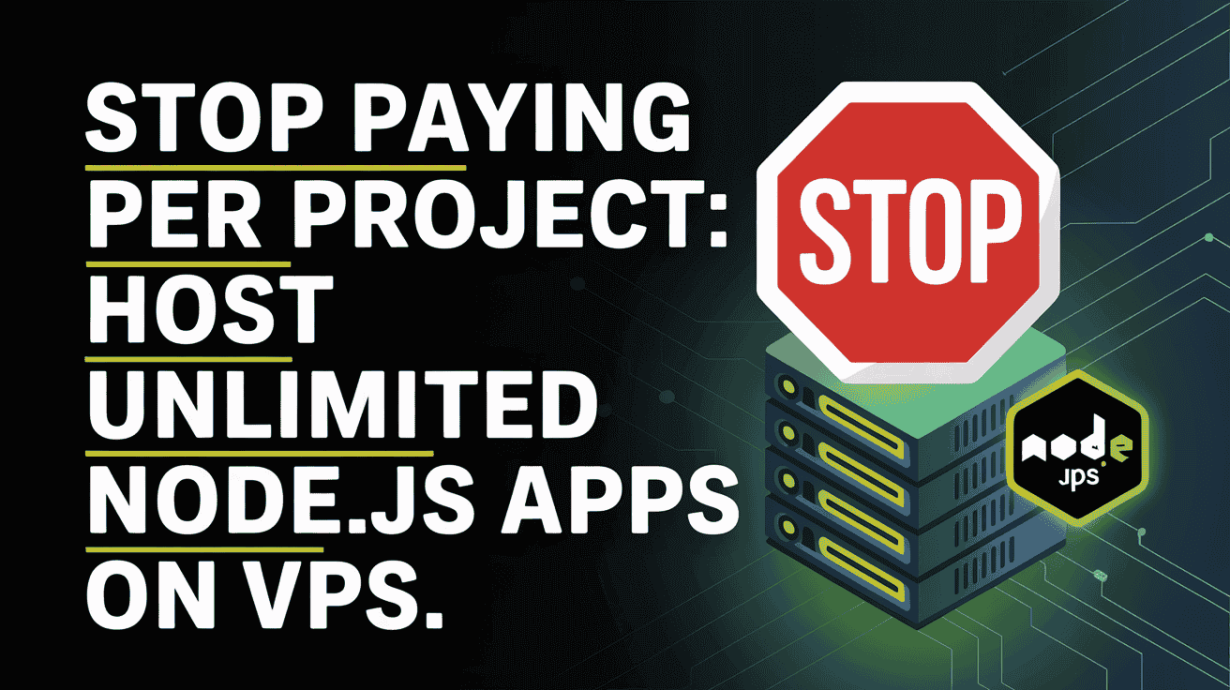
If you’re tired of your hosting bill increasing every time you create a new project, you’re not alone. Many developers are now searching for a cheap Heroku alternative for developers because paying per app has become too expensive. With Owrbit, you can host unlimited Node.js apps on VPS for one flat monthly price. One server is enough for all your projects, so you don’t get charged again and again.
In this simple Node.js hosting guide, we’ll walk through two easy ways to deploy unlimited apps on a single VPS. The main method uses CyberPanel, which is completely free and makes it easy to manage your server while still giving you full control. You’ll run apps with PM2, set up reverse proxies, and add SSL without needing any paid tools.
We’ll also explain an optional paid method using CloudLinux with DirectAdmin or cPanel. This gives you a one-click setup for Node.js apps, lets you choose versions like Node.js 20, 22, or 24, and makes everything feel almost as simple as Heroku. CloudLinux even offers a 1-month free trial, so you can try everything before paying.
Both methods help you deploy more apps without worrying about per-project costs. If you want a cheap Heroku alternative for developers that lets you build freely and keep expenses low, Owrbit’s VPS makes it easy to host unlimited Node.js apps on VPS without stress.
Let’s get started.
Why Developers Are Moving Toward a Better Hosting Model?
Here are the main reasons so many people are now looking for a cheap Heroku alternative for developers and a simpler way to host unlimited Node.js apps on VPS:

- Per-app billing gets expensive very fast :
- Every new idea, test app, microservice, or client project becomes another monthly charge on platforms like Heroku or Vercel.
- Side projects shouldn’t cost as much as production apps
- Most developers build small tools, experiments, and demos. Paying premium prices for tiny apps makes no sense.
- Multiple Node.js apps need a flexible environment
- Modern development often involves several services. A single VPS lets you host unlimited Node.js apps on VPS without thinking about limits.
- Free-tier limits keep getting smaller
- Heroku removed its free tier, and other platforms are tightening restrictions. Developers want independence, not surprise shutdowns.
- Owning a VPS gives full control
- You choose the Node.js version, install what you need, deploy however you like, and never depend on a platform’s rules.
- Scaling becomes predictable and affordable
- Instead of multiple small bills, you pay one flat price and grow your apps at your own pace.
- Better performance for the money
- A single VPS often has more RAM, CPU power, and consistency compared to shared cloud free tiers.
- Perfect for students, freelancers, and indie devs
- Anyone working on multiple projects can reduce costs and simplify their workflow.
Developers want freedom, predictable pricing, and more control — and that’s exactly why a VPS is becoming the preferred hosting model for anyone searching for a cheap Heroku alternative for developers.
Why Owrbit VPS Is a Smarter Choice Than Heroku, Vercel, or Railway?
When developers look for a cheap Heroku alternative for developers, the biggest concern is getting real performance without paying per project. This is where Owrbit’s VPS plans stand out. Instead of limiting you by apps, builds, or monthly credits, you get raw power, full control, and the freedom to host unlimited Node.js apps on VPS without any extra fees.
Here’s why Owrbit simply makes more sense:

- A plan for every developer:
- Whether you’re a student, freelancer, or running a small SaaS, Owrbit has a perfect starting point:
- Even the smallest plan has enough power to run several Node.js apps comfortably.
- Fast NVMe storage on every plan
- Starting at 40 GB and going up to 280 GB, you get fast NVMe SSD performance — far better than what most PaaS platforms offer.
- Massive bandwidth with no hidden limits
- Each plan includes 25 TB to 100 TB bandwidth. This means your APIs, dashboards, and microservices can grow without surprise overage charges.
- Unlimited inode limit
- Store as many files as your apps need — no restrictions.
- Dedicated IP and full root access
- You control everything: domains, ports, firewalls, databases, and deployment methods.
- 10Gbps network for high-speed applications
- Your apps load faster, respond quicker, and stay stable even with traffic spikes.
- IPv4 + IPv6 support on all plans
- Future-proof networking without extra fees.
- 24/7/365 support
- Whether you’re deploying your first app or running multiple production services, support is always available.
- Flat pricing — no per-app costs
- Heroku, Vercel, and Railway charge more as your project count grows.
- Owrbit charges one predictable monthly price, and you decide how many Node.js apps to host.
Owrbit gives you more RAM, more CPU power, more storage, and more freedom — all at a cost far lower than paying individually for multiple cloud apps. For anyone searching for a cheap Heroku alternative for developers, this is one of the simplest and most cost-effective ways to host unlimited Node.js apps on VPS without limits.
What You Need Before Starting Host Multiple Node.js Apps on a VPS :
Before you begin deploying your apps on an Owrbit VPS, here are the few simple things you should have ready. These basics will help you get a smooth setup, especially if you’re looking for a cheap Heroku alternative for developers and want an easy way to host unlimited Node.js apps on VPS.
Backup Your Linux: How to Backup Linux VPS Server to Cloud Storage with Rclone
- An Owrbit VPS plan that matches your needs
- The Lite VPS (2 vCPUs, 4 GB RAM) is enough for several small projects.
- If you expect heavier apps or multiple clients, higher plans like Pro, Turbo, or Elite give you more room.
- A control panel to manage everything
- CyberPanel (free) is our main method and ideal for most developers.
- DirectAdmin or cPanel (paid) give you the extra experience if you want things even simpler.
- A domain or subdomains for your apps
- You can link each project to a separate domain or use subdomains for microservices and testing environments.
- Basic comfort with uploading project files
- You just need to know how to upload your project folder using CyberPanel’s File Manager or FTP.
- Willingness to follow simple setup steps
- For the free method, we guide you through everything step-by-step.
- For the paid method, CloudLinux automates most tasks for you.
That’s all you need. With these basics ready, you’re set to turn your Owrbit server into a powerful and affordable space where you can easily host multiple Node.js apps on VPS without paying extra per project — a truly practical cheap Heroku alternative for developers.
Method 1 — The Free Way to Host Multiple Node.js Apps (Little Typical)
This is the practical Node.js hosting guide for people who want a low-cost, full-control setup. With CyberPanel and a single Owrbit VPS you can host unlimited Node.js apps on VPS without extra per-app fees. Follow these steps.
Before you start :
Assume you already have:
- An Owrbit VPS and CyberPanel installed (CyberPanel is free and beginner friendly).
- A domain or subdomains pointed to the VPS IP.
If you don’t have CyberPanel installed, you can add it quickly from CyberPanel docs — but this guide starts from a working CyberPanel.
Get Lifetime VPS : How to Get Lifetime VPS Hosting: One time Payment VPS Server
1. Connect to your Owrbit’s VPS server (SSH)
Open a terminal and SSH to your server:
ssh root@YOUR_SERVER_IPUpdate the system:
apt update && apt upgrade -y
or

yum update -y
2. Install nvm (recommended) so you can run any Node version
Using nvm lets you install Node 20, 22, 24 per project if needed:
curl -o- https://raw.githubusercontent.com/nvm-sh/nvm/v0.39.6/install.sh | bash

# then reload shell
source ~/.bashrc

# install a Node version (example)
nvm install 20
nvm use 20
node -v
Tip: use nvm for local installs or switch to system Node if you prefer.
3. Add or Create a domain in CyberPanel :
- Log into CyberPanel web UI.
- Go to Websites → Create Website.
- Enter your domain/subdomain, select options, click Create.
This creates the folder where you’ll upload the app (usually/home/yourdomain.com/public_html/).
4. Upload your Node.js project files :
You can upload via CyberPanel File Manager, FTP, or Git:
- File Manager → Upload to
/public_html/
or - Use git inside the folder:
cd /home/yourdomain.com/public_html/
git clone https://github.com/you/your-node-app.git .
5. Install dependencies :
SSH into the app folder and run:
cd /home/yourdomain.com/public_html/
nvm use 20
npm install
6. Start the app with PM2 so it stays online :
Install PM2 and start your app:
sudo npm install -g pm2
pm2 start app.js --name my-app
pm2 save
pm2 startup
PM2 keeps processes alive after reboots and restarts crashed apps.
7. Run each app on a unique port :
Make each app listen on its own port (example: 3000, 3001, 3002). Configure your apps so they use different ports:
- app A → port 3000
- app B → port 3001
- app C → port 3002
Start each with PM2 using the right port (via env var or command line):
PORT=3000 pm2 start app.js --name app-a
PORT=3001 pm2 start app.js --name app-b
8. Set up reverse proxy in CyberPanel so domains point to app ports
CyberPanel uses OpenLiteSpeed, but you can add proxy rules via the panel:
- CyberPanel → Websites → List Websites → Manage (for your domain) → Rewrite Rules
- Paste something like this (works for most setups):
RewriteEngine On
RewriteCond %{REQUEST_URI} !^/\.well-known
ProxyPass / http://127.0.0.1:3000/
ProxyPassReverse / http://127.0.0.1:3000/
Save and then restart LiteSpeed from CyberPanel (Server Status → Services).
Repeat for each domain/subdomain but change the port (3001, 3002, …). This maps domain.com → app on port 3000, api.domain.com → app on port 3001, etc.
9. Issue SSL (free) from CyberPanel :
CyberPanel has one-click Let’s Encrypt:
- Websites → List Websites → Issue SSL
Select the site and issue SSL. This secures traffic and works with the reverse proxy.
10. Test everything :
- Test locally by curling the port:
curl http://127.0.0.1:3000
- Test via domain:
https://yourdomain.com- It should load the app.
- Check PM2 status:
pm2 status
- Tail logs:
pm2 logs app-a
11. Repeat for unlimited apps :
For each new project:
- Create a new domain/subdomain in CyberPanel.
- Upload the project into that domain’s public_html.
- Give it a unique port.
- Start with PM2.
- Add reverse proxy rules and issue SSL.
This is how you host unlimited Node.js apps on VPS with CyberPanel — no per-app bill, just one flat VPS price.
12. Helpful extra steps and best practices :
- Firewall: allow only needed ports. Keep 80/443 open, block direct app ports from outside:
ufw allow 22/tcp
ufw allow 80/tcp
ufw allow 443/tcp
ufw enable
- Use environment files (.env) for secrets. Don’t commit them to git.
- Regular backups: enable CyberPanel backups or use your own scripts.
- Resource limits: monitor RAM/CPU with
top,htop, or CyberPanel metrics. Upgrade your Owrbit plan if apps grow. - Use separate databases per app when needed.
Method 2 — The Premium Easy Method: One-Click Node.js Hosting with CloudLinux
If you want the smoothest and most beginner-friendly setup,CloudLinux makes running Node.js apps almost as simple as Heroku. It adds a one-click interface for creating apps, selecting Node.js versions, and keeping everything isolated. This method is perfect for developers who want an easier workflow and a cheap Heroku alternative for developers that still gives full control through a VPS.
Although CloudLinux can work with CyberPanel, the best experience comes when using DirectAdmin or cPanel, because these panels offer the cleanest integration with CloudLinux’s features. DirectAdmin’s personal license usually starts around $5 per month, while cPanel Solo (single account) is around $26.99 per month.
Checkout Top 7 Best Free Web Hosting Control Panels for VPS Server If you want any other control panel.
What CloudLinux Adds :
CloudLinux gives you a powerful Node.js environment with almost no terminal commands. Here’s what it brings:
- A simple app creation interface (choose app folder, app start file, port).
- Node.js version selection like Node.js 20, 22, or 24.
- Built-in isolation so multiple apps never interrupt each other.
- Easier error logs, process controls, and app restarts.
- A free trial period so you can test everything before paying.
These features make it much easier to host multiple Node.js apps on VPS without needing deep Linux knowledge.
Step-by-Step: Deploying a Node.js App Using CloudLinux:
Follow these steps to get a fully working app with minimal effort.
Step 1: Enable or Install CloudLinux
- Once you purchase or activate CloudLinux on your Owrbit VPS, it replaces the base system with CloudLinux OS and enables its isolation features.
- If needed, Owrbit support can also help enable CloudLinux for you.
Step 2: Choose Your Control Panel :
CloudLinux works best with:
- CyberPanel – Free Open Source Control Panel
- DirectAdmin – affordable and reliable for beginners
- cPanel – the most polished and beginner-friendly interface
Once installed, The panel dashboard will show CloudLinux’s features, including the Node.js app setup tool.
Step 3: Enable Node.js Selector Inside CloudLinux
- Inside the panel (CyberPanel, DirectAdmin or cPanel), open the CloudLinux or LVE Manager section and turn on the Node.js system.
- Choose which Node versions you want to offer, such as Node.js 20, 22, or 24.
Step 4: Create Your Node.js App (The One-Click Part)
- Log into your hosting panel.
- Open the “Setup Node.js App” or “Application Manager” section.
- Choose your Node.js version.
- Select your application folder (this is where your code is stored).
- Set the app start file (example: app.js or server.js).
- Click Create or Start.
The panel automatically builds your environment, installs the runtime, and wires everything together for you.
Step 5: Upload Your Project Files
Upload your app folder through the File Manager or via FTP, then refresh the Node.js panel so it detects the app files.
Step 6: Install Dependencies
Inside the app manager, there is usually a button to run commands like:
- npm install
- npm update
This installs everything your app needs.
Step 7: Assign a Domain and Enable SSL
- Assign your domain to the app using the same control panel interface.
- Enable free SSL using the Let’s Encrypt tool.
- CloudLinux and the panel handle the proxying automatically, so no manual reverse-proxy rules are needed
Step 8: Test Your Application
Visit your domain:
https://yourdomain.comYour app should load instantly.
Check logs in the Node.js app manager if you need to debug anything.
Step 9: Repeat for More Apps
You can create multiple Node.js applications on the same VPS:
- Each app has its own folder
- Each app can use its own Node.js version
- Each app stays isolated so one project never affects another
This is exactly how you host multiple Node.js apps on VPS the easy way.
Pros and Cons of the CloudLinux Method :
Pros
- Easiest method for beginners
- One-click Node.js app creation
- Choose Node.js versions per project
- Apps stay isolated and stable
- No manual reverse proxy steps
- Great for teams, agencies, and production workloads
- Feels close to PaaS platforms while costing much less
Cons
- Requires CloudLinux license starting from 12$/mo
- DirectAdmin or cPanel adds extra monthly cost
- Slightly more expensive than the completely free CyberPanel method
- Less customizable for advanced users who prefer full terminal control
CloudLinux gives you the simplest way to deploy apps on your Owrbit VPS while keeping everything organized, isolated, and easy to manage. It’s perfect if you want a smooth experience, predictable results, and a cheap Heroku alternative for developers without per-app pricing.
Free vs Paid Method: Which Should You Choose?
Both options let you host multiple Node.js apps on VPS without paying per project. The difference comes down to how much simplicity you want and how much you’re comfortable managing on your own.
Checkout Linux VPS Hosting: Key Benefits of Using a Linux VPS Server
Side-by-Side Comparison Table :
| Feature / Method | CyberPanel (Free) | CloudLinux (Paid Easy Method) |
|---|---|---|
| Monthly Cost | Free | Starts around $12/month (with 1-month free trial) |
| Difficulty Level | Moderate | Very easy |
| Node.js Setup | Manual installation | Built-in Node.js App selector |
| Node.js Versions | You manage using nvm | Choose Node.js 20, 22, 24 from panel |
| Reverse Proxy | Manual rewrite rules | Automatically handled |
| SSL | One-click via CyberPanel | One-click, fully integrated |
| App Isolation | Basic | Strong per-app isolation |
| Best For | Budget setups, students, freelancers | People who want the simplest deployment |
| How Many Apps? | Unlimited | Unlimited |
| Works as Cheap Heroku Alternative? | Yes | Yes, even easier |
Who Should Choose CyberPanel (Free Method) :
Go with CyberPanel if:
- You want the most budget-friendly setup
- You’re comfortable following simple SSH steps
- You enjoy having full control over your environment
- You’re a freelancer, student, or hobby developer
- You want a cheap Heroku alternative for developers without paying for extra features
CyberPanel gives you complete freedom and zero license fees, making it perfect for hosting multiple Node.js apps on VPS.
Who Should Choose CloudLinux (Paid Easy Method)
Choose CloudLinux if:
- You want a one-click way to create Node.js apps
- You want automatic reverse proxy setup
- You want built-in version selection (Node.js 20, 22, 24)
- You prefer strong app isolation for stability
- You don’t want to touch SSH or manual configuration
- You want the simplest way to host multiple Node.js apps on VPS
CloudLinux pricing typically starts around $12 per month, and it also includes a 1-month free trial, so you can test everything before deciding.
Cost Comparison Over 12 Months
This helps you understand long-term costs:
CyberPanel (Free Method)
- Panel: $0
- CloudLinux: $0
- Owrbit VPS: your chosen plan
- 12-month total: VPS cost only
CloudLinux (Paid Easy Method)
- CloudLinux license: ~$12 × 12 = ~$144 per year
- Owrbit VPS: your chosen plan
- 12-month total: VPS cost + ~$144 yearly
Final Choice Summary
- Choose CyberPanel if you want full control and the lowest cost.
- Choose CloudLinux if you want the easiest, fastest, and most user-friendly setup.
Either way, Owrbit gives you a reliable and affordable way to host multiple Node.js apps on VPS, making it one of the strongest cheap Heroku alternative for developers today.
Why Owrbit VPS Is the Best Place for Hosting Unlimited Apps
When developers look for a cheap Heroku alternative for developers, the biggest question is simple:
Can I run all my projects on one server without limits, high costs, or complicated setup?
With Owrbit, the answer is yes. Owrbit VPS plans are designed to give you the freedom to host multiple Node.js apps on VPS without paying extra for each project. Whether you’re building APIs, dashboards, microservices, student projects, or client apps, everything runs smoothly under one predictable monthly price.
Here’s why Owrbit stands out:

- One VPS, Unlimited Apps
- All Owrbit VPS plans allow you to run as many Node.js apps as you want. No extra charges, no per-app billing, and no hidden limits.
- Powerful Hardware for Real Performance
- Every plan includes fast NVMe SSD storage, generous bandwidth, dedicated CPU power, and strong RAM options. Your apps load fast, stay responsive, and scale easily as traffic grows.
- Full Freedom to Choose Your Deployment Style
- Use CyberPanel for the free method or CloudLinux for the easy, one-click method—both work perfectly on Owrbit. You decide how simple or advanced you want your setup to be.
- No Sleeping or Pausing of Apps
- Unlike some cloud platforms, your apps never sleep or shut down. They stay online 24/7, which is critical for APIs, production services, and client projects.
- Future-Proof Networking
- Each VPS includes IPv4, IPv6, and high-speed network connections, so your apps stay fast and globally reachable.
- Beginner-Friendly Yet Powerful
- Even if you’re new to VPS hosting, Owrbit makes things simple. You can follow our free CyberPanel setup or switch to CloudLinux if you prefer a more automated experience.
- Affordable and Transparent Pricing
- You pay once per month, and that’s it. No extra charges for more apps, more repos, more domains, or more deployments. This makes Owrbit a practical and predictable hosting choice.
- Perfect for Developers, Freelancers, and Agencies
- Run all your side projects, prototypes, and client apps on one server. Upgrade anytime as you grow—your workflow remains the same.
Owrbit VPS gives you power, flexibility, and low cost—all in one place. If you want to host multiple Node.js apps on VPS without worrying about per-app fees, Owrbit is one of the best and most affordable solutions available today.
It’s fast, simple, and one of the most reliable cheap Heroku alternative for developers looking to take control of their hosting.
Frequently Asked Questions :
Here are the most common questions developers ask when switching from platforms like Heroku or Vercel to hosting multiple Node.js apps on an Owrbit VPS. These answers will help you understand how everything works, what it costs, and why this setup is a strong cheap Heroku alternative for developers.
Is Owrbit a good cheap Heroku alternative for developers?
Absolutely. Owrbit offers predictable, low monthly pricing with no per-app charges. Unlike Heroku, Vercel, or Railway, you are not billed every time you deploy a new project. This makes Owrbit a strong and affordable cheap Heroku alternative for developers who want simplicity and full control.
Do I need to know Linux to host multiple Node.js apps on VPS?
Not necessarily. With CyberPanel (free) or CloudLinux (paid easy method), you can deploy Node.js apps with minimal or zero Linux commands. The free method uses simple steps, while CloudLinux offers one-click deployment for beginners.
How do I run multiple Node.js apps on different domains?
Each Node.js app runs on its own port (like 3000, 3001, 3002). Using CyberPanel or CloudLinux, you can map each domain or subdomain to the correct port. This allows you to host multiple Node.js apps on VPS without conflicts.
Which control panel is better for Node.js hosting: CyberPanel or CloudLinux?
CyberPanel is free and great for budget-friendly hosting, while CloudLinux offers the easiest one-click setup for Node.js apps. If you want the lowest cost, choose CyberPanel. If you want the simplest experience, CloudLinux is better.
How much does CloudLinux cost for Node.js hosting?
CloudLinux pricing usually starts around $12 per month and includes advanced features like Node.js version selection, app isolation, and a one-click deployment interface. It also offers a free trial so you can test everything before paying.
Can I host Python apps and Node.js apps together on the same VPS?
Yes. Both CyberPanel and CloudLinux support Python apps along with Node.js. You can run multiple apps of different types on the same Owrbit VPS as long as your resources allow it.
Will my Node.js apps stay online if one app crashes?
Yes. Using PM2 (in the CyberPanel method) or CloudLinux’s built-in process manager (in the paid method), each Node.js app runs independently. One app crashing will not affect the others, and process managers will restart apps automatically.
Is a VPS faster than Heroku, Vercel, or Railway for Node.js hosting?
In most cases, yes. Owrbit VPS offers dedicated CPU, RAM, and NVMe storage, giving you consistent performance. PaaS platforms often use shared resources, which can slow down your apps during peak times.
How much RAM do I need to host multiple Node.js apps on VPS?
A 2–4 GB RAM VPS is usually enough for several small apps or APIs. For more demanding workloads, 8–16 GB RAM is recommended. You can scale up your Owrbit VPS anytime as your apps grow.
These FAQs cover the biggest concerns developers have when moving to a VPS-based setup. Once you understand these basics, you’ll see how easy and affordable it is to host multiple Node.js apps on VPS using Owrbit. If you need help choosing the right plan or setting up your first app, our team is always ready to guide you.
Final Thoughts: The Smarter Way to Host All Your Node.js Projects
Switching from platforms like Heroku, Vercel, or Railway doesn’t have to be expensive or complicated. In this guide, we showed how Owrbit gives you the freedom to host multiple Node.js apps on VPS without paying per project — something developers have been searching for as a true cheap Heroku alternative for developers.
You learned two powerful ways to deploy your apps:
- The free method using CyberPanel, which gives you full control at zero extra cost.
- The easy paid method using CloudLinux, which provides one-click app creation, version selection, and strong app isolation.
We also explored why developers are moving away from per-app billing, how Owrbit’s VPS plans provide more performance for the money, what you need before getting started, and how to decide between the free and paid methods based on your budget and workflow.
No matter which option you choose, Owrbit makes it simple to run unlimited apps under one predictable monthly price. You get speed, stability, flexibility, and the freedom to scale your ideas without worrying about extra charges.
If you’re ready to take control of your hosting, save money, and deploy as many projects as you want, Owrbit VPS is one of the most practical and developer-friendly paths forward. Start hosting smarter today.
Discover more from Owrbit
Subscribe to get the latest posts sent to your email.